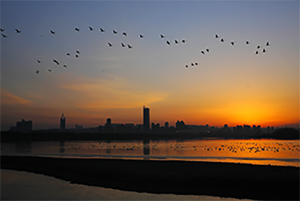
The first Swan research center in China was established
On November 22, Sanmenxia Swan Research Center, the country's first Swan Research Center, was successfully unveiled to protect the swan and its habitat, consolidate the achievements of the city's ecological civilization construction, and make use of the city's unique Swan resources to study scientific research topics such as the scientific protection of the swan.
On the day of unveiling, our city signed a co construction agreement with Changchun wild animal disease research center of State Forestry and grassland administration, and appointed Gao Yuwei and Wang Tiecheng as chief experts and distinguished experts of Changchun wild animal disease research center of State Forestry and grassland administration, as well as 10 special researchers, Carry out research on the ecological biology of the swan, the ecological monitoring of the Swan population, the ring of the swan, as well as the living habits, migration laws and epidemic prevention and control of the swan, and carry out research on the relationship between urban ecology and the swan in our city.
In recent years, guided by the thought of Xi Jinping ecological civilization, our city has actively implemented the national strategy of ecological protection and high-quality development in the Yellow River Basin, invested a lot of human, material and financial resources, made great efforts to improve the ecological environment of the Yellow River Wetland and strive to build a warm home for the swan. In 2010, our city was awarded the first title of "hometown of Chinese big swan" by China Wildlife Protection Association. In 2015, six Swan babies were successfully bred naturally in our city. In 2019 and 2020, wild swans propagated naturally in the Yellow River Wetland of our city for two consecutive years. With the continuous strengthening of protection, the number of big swans living and wintering in our city is increasing year by year. In 2020, the number of big swans exceeded 15000, a record high, accounting for more than two-thirds of the number of big swans wintering in China. Therefore, our city has become the largest habitat and viewing area of big swans in China.
According to the statistics of the Municipal Forestry Bureau, as of November 24, the number of overwintering swans in our city has reached 7800, attracting many tourists and photography lovers.