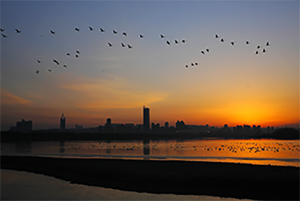
Nearly 5000 White Swans Flew to Sanmenxia
Recently, due to the fine weather, more and more white swans fly to Sanmenxia for winter. The reporter learned from Sanmenxia Forestry Bureau that until Nov.10th there were more than 4790 white swans in Sanmenxia, they mainly distributed in Sanmenxia Swan Lake National Urban Wetland Park, Swan Bay in Sanmenxia Urban-rural Integration Demonstration Area, and Wangguan Yellow River Wetland in Hubin District and so on.
Tourists who desire to watch swans need to show their ID card and enter the park with their real name, and the park has already suspended the reception of tourists with a history of living in medium and high-risk areas or in the city where has confirmed cases, in order to further strengthen the epidemic prevention and control, according to the relevant people in charge of Sanmenxia Swan Lake National Urban Wetland Park. Recently, before entering the scenic spots, tourists outside Henan province or tourists with a history of living outside Henan Province within 14 days should prepare the negative nucleic acid test certificate within 48 hours , health code, travel code and admission reservation code in advance, wear masks and measure their body temperature. Tourists in Henan Province should take other protective measures except nucleic acid certificates. More than 10 working staffs are arranged in the scenic area to patrol 24 hours a day to prevent tourists from feeding and approaching swans at will. When a large number of swans gather stably, the scenic spot will regularly disinfect the whole park to prevent swans and tourists from contracting bird flu and other diseases.
At present, there are more than 1200 swans in Sanmenxia Urban-rural Integration Demonstration Area. The number is growing continuously, and they mainly concentrated in Swan Bay in Houdi village and Beiying village, Dawang town. In recent years, the region has attached great importance to the ecological restoration and protection of the Yellow River, and adhered to the policy of protection and ecology are the first and natural restoration is the main task , which make this wetland a paradise for migratory birds. More and more white swans come here to live for winter.
According to the relevant people in charge of the Agricultural Service Center of Dawang Town in Sanmenxia Urban-rural Integration Demonstration Area, working staffs had disinfected the habitat of the white swan in Swan Bay prior to the arrival of swans, and then disinfected it once a month so as to do a good job in the prevention and control of epidemics. It is reported that there set checking booths at the entrance of each village into the Yellow River Ecological Corridor. Tourists need to take their temperature and show their health code and travel code when entering Swan Bay from here. Then tourists are permitted to watch Swans along the newly-built 600m wooden boardwalk in Swan Bay and the Yellow ecological corridor in Beiying village.
In addition, working staffs in Swan Bay patrol and guard the safety of white swans every day, Especially when the number of swans reaches the peak, working staffs will strengthen the patrol and provide guidance for tourists and standardize the civilized viewing.
Wangguan Yellow River wetland is located in the Wangguan Yellow River intertidal zone , there were 520 white swans inhabiting there until November 9th. It is also the first stop for white swans to migrate to Sanmenxia. After mid October every year, white swans from Siberia, Inner Mongolia and other places always stop at Wangguan Yellow River Wetland for a short time, and then fly to Sanmenxia Swan Lake,Yellow River Park, Swan Bay in Houdi village and other white swan habitats. Until the March of next year, these swans will be concentrated in wangguan Yellow River Wetland again, and then return to the north together.
According to the relevant persons in charge of Sanmenxia Yellow River Wetland Management Office, prior to the arrival of swans, they have organized staff to disinfect the Wangguan Yellow River Wetland. Later, they will reasonably arrange the disinfection work according to the actual situation, and they arrange special staffs for 24-hour patrol to count and report the number of swans on that day, discourage individual uncivilized behaviors, and guide tourists to watch swans in a civilized way. Recently, the Yellow River Wetland Management Department has newly installed five monitoring stations within the wetland to ensure the safety of white swans with the combination of personnel defense and technical defense.